Spooktober, Day 13: Kwaidan by Lafcadio Hearn

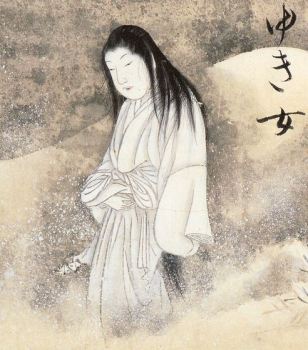
Suuhi_Yuki-onna.jpg

“He was awakened by a showering of snow in his face. The door of the hut had been forced open; and, by the snow-light (yuki-akari), he saw a woman in the room,— a woman all in white.”

Horror is universal, but ghost stories don’t always have the same cultural context. In Britain, ghost stories are usually reserved for the winter months: for Halloween, as summer dies and gives way to winter; or at Christmas, when the night is darkest, and the whole world seems filled with a neverending chill. But in Japan, ghost stories are associated with summer: they are told at twilight on warm nights, to cool the blood. According to Shinto belief, humanity shares the world with a myriad of gods, spirits and mysterious creatures: and if we wander too far, or speak to the wrong person at sunset, we may not come back the same.

Lafcadio Hearn was one of the first writers to bring Japanese folklore to a broader Western audience. Hearn’s life is fascinating in itself: a Graeco-Irish journalist who immigrated to New Orleans (he wrote an obituary for Marie Laveau) and later settled in Japan and wrote many books about his adopted homeland. His work has been adapted several times for TV, film and anime, and Kwaidan: Stories and Studies of Strange Things is perhaps his most enduring work.

Ostensibly, Kwaidan is a collection of ghost stories and folk tales that Hearn collected, translated or heard from others, though it’s possible that he created or at least embellished some of the stories himself. The tales serve as bite-sized tastes of Japan’s folkloric fringe: they include yuki-onna, the snow woman, who preys on travellers lost in a blizzard. Then there’s Hoichi the Earless, the minstrel doomed to play for a band of ghostly samurai. And it includes the tale of Akinosuke, who dreams a whole new life for himself, only to see it disappear when he awakens. There’s also an entire appendix devoted to Hearn’s fascination with entomology if you want to read about why ants are better than people.

Kwaidan is a strange book, written by a strange man, about strange things. It’s written in the direct, matter-of-fact tones of fairy tales the world over, with little of the concern for characterisation or mood one might see in “real” horror, but the simplicity of Hearn’s prose allows the reader to put together the pieces for themselves as they imagine the strange creatures within. The stories work best when they are read allowed as they were intended: as the sun goes down and the light begins to change, and you long for a chill to run down your spine…

Read Kwaidan here

Spooktober, Day 12: Rebecca by Daphne du Maurier

rebecca.jpg

“Last night I dreamt I went to Manderley again.”

One of the themes that have come up repeatedly while writing these posts for Spooktober (“The Spooksiest Time Of The Year!tm”) is that great horror is not always about supernatural monstrosities invading our every day lives.

Nowhere is this more clear than in Daphne du Maurier’s classic gothic thriller, Rebecca.

It’s a tale as old as time: girl meets boy, girl marries boy, girl moves into boys expansive stately home in the country, girl finds herself haunted by the ongoing presence of boy’s impossibly glamorous ex-wife, girl is threatened by boy’s obsessive old housekeeper, boy’s house burns down. How often have we heard that tale?

It’s a novel about a haunting that doesn’t include a single (literal)  ghost. Rebecca herself is a presence and character despite her posthumous status:  Because so much of the action is going on in Mrs de Winter’s head, blurring the line between reality and imagination. She is a character in a constant state of anxiety, forever comparing herself to her predecessor and making assumptions about what other characters think about her. She is, in a sense, gaslighting herself, just as Mrs Danvers subtly undermines her self-confidence and keeps alive the memory of the former mistress. Du Maurier’s genius lies in her ability to build up this sense of unease into fear as the story progresses. Anyone looking to write horror or build tension would do well to read, study and absorb the lessons of Rebecca.

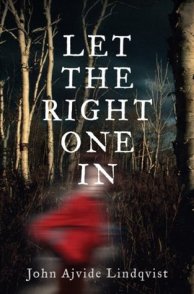
Spooktober, Day 11: Let the Right One In, by John Ajvide Lindqvist

943402.jpg

“Are you OLD?”

“No. I’m only twelve. But I’ve been that for a long time.” 

It’s 1981. Young Oskar is living with his mother, bullied at school and faces visits from his alcoholic father. Then he meets, Eli, the girl who’s just moved in next door, and he’s finally found someone who understands him. There’s only one problem: Eli is a vampire, and the man claiming to be Eli’s “dad” may or may not be a child molester who provides Eli with the blood they need to survive.

Let the Right One In works because like the best vampire stories, it’s not really about vampires. There are monsters-a-plenty in Lindqvist’s world, all of them terrifyingly real: bullies, alcoholics, neglectful adults and child molesters, to name just a few. Honestly, the horrors in Oskar’s life are so unsettling that a centuries-old haemophage looks positively quaint in comparison.

Maybe that’s why Oskar’s relationship with Eli works so well, since Eli is, strangely enough, the warmest and most sympathetic character in Oskar’s life. It subverts our expectations on the innocence of childhood, yet somehow reinforces them at the same time. Their relationship may be unconventional, but its also genuinely sweet and tender, and you can’t help but hope that their friendship will somehow endure the carnage going on around it.

Let The Right One In is a masterpiece of Scandi noir, an extended meditation on the dark side of the human soul. It’s unrelentingly brutal, which only serves to make its moments of joy gleam all the brighter. It’s essential reading for anyone who thinks vampire fiction has gotten “soft,” or for a crossover thriller with light supernatural elements. After all, not all monsters have fangs…

Spooktober, Day 10: The Ring, by Koji Suzuki

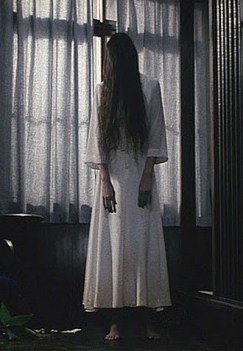
06-Sadako-1.jpg

‘Before you die, you see the ring…’

Today’s entry in our Spooktober marathon is going to be a little different because although The Ring was initially a novel by Koji Suzuki, I’m going to be talking mostly about the film adaptation(s). Why? Because The Ring is one of those rare anomalies where I honestly believe that the film adaptation is better than the original novel. Partly it’s because I’ve only read the book in translation; partly it’s because the films excise some of the more problematic aspects of the novel (including, the more sordid details of Sadako’s backstory, and Ryuji’s rather tasteless enthusiasm for sexual assault). Mostly I think it’s because this is a story that works better with a supernatural bent than a pseudo-scientific explanation: Sadako in the film is a ghost, in the Japanese tradition of vengeful onryo, rather than a combined electromagnetic/psychic manifestation of syphilis. But then, the first movie was directed by Suzuki himself, so it’s not like I’m downplaying his role by stating a preference for the film.

It’s also unusual in that the western remake is not only competent but arguably as good as the original. So whichever interpretation is your favourite is up to you.

In case you’re not familiar with it, The Ring is the story of a cursed videotape that kills anyone who watches it, and the desperate quest to find a way to stop it. Although it felt fresh and new to a Western audience, The Ring is actually working within a rich tradition of Japanese horror: ghoulish spirits seeking vengeance with power they never had in life; haunted, animated technology; the invasion of the everyday by the uncanny. It all reads like a subversion of the typical ghost story tropes, leading to an end that puts a genius (and savage) twist on the hope that appeasing the spirit will deflect its vengeance. Yet it’s also subtle: the Japanese film only features one horrifying moment towards the end, but I still had to stop and switch on the lights a couple of times while watching as the tension built but was never really allowed to deflate. It’s a work that lingers long after it’s over by playing on our paranoia, by stoking the fear that our everyday environment and all our technological comforts could be used against us.

Spooktober, Day 9: Maplecroft by Cherie Priest

851510149022922414.jpg

“This evil cannot hide from me. No matter what guise it assumes, I will be waiting for it. With an axe.”

Stop me if you’ve heard this premise before: a novel with notorious murderer Lizzie Borden as the protagonist, fighting Lovecraftian monsters from the sea. How many times have we heard that old chestnut?

The premise of Maplecroft by Cherie Priest is that Lizzie Borden was mistakenly charged with axe-murdering her parents, who had begun to transform into Things That Cannot Be. Now, Lizzie has retreated to her new home, Maplecroft, along with her sickly sister, Emma, where they keep an eye on the sea and guard against the encroaching hoards of fish-monsters. But the story is rooted in human drama: in Lizzie’s growing fatigue from caring for her sister while fighting monsters at night when all she wants is to spend time with her girlfriend. Emma, meanwhile, is determined to prove her worth as a biologist by sending away a sample her sister finds on the beach…

I love Cherie Priest: she has such a knack for narrative voice, for nailing the feel and tone of a place and time. She takes a premise that sounds far out on paper and manages to inject it with gravitas, filling the story with a creeping sense of dread as madness descends on the Borden sisters. Maplecroft is a beautiful hybrid of historical crime thriller and cosmic horror, and I’d recommend it to anyone looking for a little bit more from their Lovecraftian fiction.

Spooktober, Day 8: The Graveyard Book by Neil Gaiman

718246._SX540_.jpg

People want to forget the impossible. It makes their world safer.

I have become convinced that Neil Gaiman is some a wizard. Because every story he writes somehow seems so effortless, so easy to read but jam-packed full of imagination. The Graveyard Book may not be my favourite of his novels (*coughs*American Gods*coughs*), but it’s definitely his most accessible.

The Graveyard Book is the story of Nobody “Bod” Owens, who is orphaned in the intro by a serial killer and raised in a nearby cemetery by a family of ghosts and a reformed vampire. Most of the book is made up of a series of short stories and vignettes about Bod’s adventures growing up in the graveyard, encountering ghosts and witches and werewolves and a human girl who slowly tempts him to rejoin the world of the living. And if anyone of this sounds familiar: yes, it is based on Rudyard Kipling’s Jungle Book.

The Graveyard Book is a delight for all ages: it’s horror-themed without being too intense for young readers, while well-written and layered enough that it never feels “childish”. So if you’re looking for a break from all the terror of Halloween but still feel in the mood for something spooky, check it out.

Spooktober, Day 7: Dracula, by Bram Stoker

Vlad.dracula.jpg

“No man knows till he has suffered from the night how sweet and dear to his heart and eye the morning can be.”

Is there anything more that needs to be said about Dracula? Probably not: the Count’s presence in pop culture is so significant that even the parodies are old and cliched. Still, there’s good reason the old Count’s done as well as he has (besides looking fabulous in an opera cape), and if your only exposure to Dracula has been through his movies, you really owe it to yourself to read the original. And if you have read it, you should read it again.

Shorn of the crust that has accrued around him, the Count is far from his postmodern persona of the urbane gentleman; he may appear civilised, but at his core, he is little more than a sentient disease. Part of his ubiquity lies in the number of fears that he embodies: fear of contamination, of sex, of the other, of nature. Dracula is a boggart; he’s Pennywise; he represents all our worst fears. He is the wolf pack hiding in the forest, stalking us as we stray away from civilisation. He is the taint of madness and disease lurking in our blood He is syphilis, a walking STD, an idea that has lingered in horror ever since, linking sex and mortality in the most literal way I’ve seen until It Follows.

And yes, he’s xenophobia made flesh. At its heart, Dracula is still problematic: its chauvinistic, sexist and firmly in defence of the status quo. At its core, it’s a rallying cry against the Other, a warning about “bloody foreigners, coming over here, sucking the blood from our women!” It’s part of a broader genre of invasion fiction where the backwards and uncivilised foreigner is driven from the metropole back by the WASPy heroes. Its treatment of mental illness is regressive. The women in the book are idealised and victimised and never allowed to tell their own story.

It’s essential to place Dracula in the context of its time because it’s still a great read, still a masterpiece of pacing and perhaps the example par excellence of what can be done with an epistolary novel. Come in, the night air is chill, and you must need to eat and rest…

Spooktober, Day 6: The Zombie Survival Guide and World War Z, by Max Brooks

51pZ-vImfOL._SX321_BO1,204,203,200_.jpg

“Ignorance was the enemy. Lies and superstition, misinformation, disinformation. Sometimes, no information at all. Ignorance killed billions of people. Ignorance caused the Zombie War. Imagine if we had known then what we know now. Imagine if the undead virus had been as understood as, say, tuberculosis was. Imagine if the world’s citizens, or at least those charged with protecting those citizens, had known exactly what they were facing. Ignorance was the real enemy, and cold, hard facts were the weapons.”

Funnily enough, I’ve never been that crazy about zombies.
I love ghost stories because there’s an undercurrent of hope to them, a belief in a world after this one that I find comforting as well as disturbing. And I’m okay with vampires and werewolves, especially now that we’re past their glut in speculative fiction— they scared me when I was young, so I can’t help but think of them as a bit childish. But I’ve never really grokked zombies. Maybe it’s because they’re so often used poorly, as set decoration or comic relief or shock troops of the apocalypse. Or maybe its because when they’re used well, it’s because writers employ as social commentary: as a metaphor for consumerism or elite exploitation of the proletariat. Maybe it’s a quirk of my brain that I’ve read The Woman in Black three times and seen the stage play, but I can’t stand to watch a single episode of Black Mirror because while I’m okay with ghosts, actual human suffering freaks me out too much.
It’s telling, then, that I loved The Zombie Survival Guide and World War Z so much.
I expected The Zombie Survival Guide to be a comedy, but it soon became clear that it was deadly serious: Brooks had obviously put a lot of thought (and no small amount of real-life research) into how to survive a zombie outbreak. And it’s not really funny, it’s terrifying because the demands are so high. How do you survive the zombiepocalypse? Get fit; learn martial arts; prep your cellar; buy a property in the highlands; drop out of school or work and get ready. To survive the hordes of the undead, you need to become a crazy survivalist. And you need to start yesterday.
The message of The Zombie Survival Guide is even more horrifying than the thought of the coming plague: the subtext of the book is that even if you were to give up everything you own and love, you are still not ready. Reading The Zombie Survival Guide feels like a personality test at the back of a lifestyle magazine: every page challenges you, asks if you’re prepared to do what’s necessary, and it becomes depressingly evident with each new chapter that the answer is always no. You’d better pray that the zombies never become real because you are royally screwed if they do.
The one consolation is that so is everyone else.
World War Z builds on the idea and scales it up: not only are you personally not ready for a zombie outbreak, but neither is society. World War Z is presented as an oral history of a hypothetical zombie outbreak, consisting of a series of first-person vignettes contributing to a bigger picture. They are more or less universally awful: examples include the US military’s woeful lack of preparation, Israel’s creation of a defensive wall to keep out refugees and South Africa’s adaptation of a horrific plan to curtail the population in case of a rebellion against apartheid into a cold-hearted but practical plan to curb the zombie flood. It presents humanity at its absolute worst, as vain, self-centred, paranoid and stupid, and time has only shown it to be eerily prescient.
There are moments of joy and success to be had that are all the better for feeling hard-fought: the Japanese otaku who becomes a ninja to survive; or the entirely too awesome way the US Army ultimately defeats the zombies with the power of The Trooper. But in the end, the world is still broken, the zombies are still there, lying in the permafrost and the whales are all dead from overfishing and the horde of zombies lurking under the waves…

Spooktober, Day 5: The Haunting of Hill House by Shirley Jackson

8739042212_23c187a117_b.jpg

The Haunting of Hill House by Shirley Jackson is the haunted house story. Its influence echoes throughout every form of media,  in every story dealing with a haunted location. From The Shining to Silent Hill, entire generations of writers have taken influence from Jackson’s iconic locale, a house that is itself a character as much as a setting. It has been adapted for film twice, with a third coming to Netflix: the 1963 version, The Haunting, is recognised as one of the classics of horror cinema. The 1999 version… is not.

Jackson sets out her stall in the opening paragraph, cited by Stephen King as one of the best in English literature:

“No live organism can continue for long to exist sanely under conditions of absolute reality; even larks and katydids are supposed, by some, to dream. Hill House, not sane, stood by itself against its hills, holding darkness within; it had stood so for eighty years and might stand for eighty more. Within, walls continued upright, bricks met neatly, floors were firm, and doors were sensibly shut; silence lay steadily against the wood and stone of Hill House, and whatever walked there, walked alone.”

The story centres around the four characters who dare to stay within the walls of Hill House: a paranormal investigator; a nervous recluse; a bohemian artist; and the duplicitous heir to the property. During their stay, they all experience strange events and begin to uncover the sordid history behind the house, and by the end, the reader is still left wondering how much is real and how much is imaginary.

The Haunting of Hill House is a touchstone of the horror tradition. It understands that nothing is more frightening than whatever the reader can imagine. Jackson’s gorgeous, literary prose gives away nothing: it’s never made explicit whether the events that the characters perceive are real or just products of the strain on their minds. Its genius is that it recognises that no horror on the page can ever match what we create ourselves. It’s a book that forms a psychic echo chamber around the reader, which allows our own worst fears to rattle around inside, becoming larger and more potent with every moment. It is a vital, compelling book that everyone who is interested in reading or writing horror should read.

And as luck would have it, it’s currently on sale for Kindle.

Spooktober, Day 4: Dark Matter by Michelle Paver

Dark-Matter-jacket-600x887.jpg

When you think about it, the Arctic is the perfect setting for a horror story: it’s pitch dark for half the year, it’s isolated, and just about everything out there will try and kill you.

Michelle Paver’s Dark Matter tells the story of an expedition to the Arctic island of Svalbard. The narrator, Jack Miller, jumps at the chance to prove himself by joining a pack of Oxford graduates on their adventure north, to Gruhuken Bay, despite his worries about the class divide. The expedition is struck by bad luck from the outset, and the misfortunes pile up until every member of the team is forced to leave, leaving Jack on his own to mind the camp and keep the mission going. As if the cold and the darkness wasn’t enough, Jack has to face the possibility that Gruhuken isn’t as abandoned as he thought.

Dark Matter is a superb psychological horror story, focusing consistently on Jack’s worsening mental state. As Jack’s situation deteriorates, there is a growing sense that there must be something out there, some malevolent presence that wishes him harm. It’s written in the best tradition of psychological horror, ratcheting up the tension that something might happen without ever deflating it by showing the monster in the flesh. Indeed, It’s left ambiguous exactly how much of the events that are going on is real and how much is going on in Jack’s imagination.

I read Dark Matter over the course of a single weekend last year, and I can’t recommend it enough. It’s a traditional ghost story, full of ignored warnings and the gradual reveal of buried secrets, but the Arctic setting makes it feel fresh and original. A word of advice, though: make sure you wrap up warm and keep a dog nearby if you have one…

I’d also recommend Paver’s follow-up novel, Thin Air, which has a similar premise and style but is based on a mountaineering expedition in the Himalayas that left me dizzy with vertigo.